 arky
Open arky ↗
arky
Open arky ↗
USDC prediction markets on Arc: how they work
On arky, the trading terminal on Circle's Arc chain, prediction markets use USDC for everything: you buy YES or NO shares with USDC, pay gas in USDC, and redeem each winning share for 1 USDC once the market settles onchain. A built-in market maker quotes a price every block, and shorter 5- and 15-minute Up/Down rounds run alongside.
This page explains the mechanics behind arky's markets: what you buy, how prices move, who settles a market and how you get paid. For the general theory, see how prediction markets work.
Why use USDC for prediction markets on Arc?
USDC on Arc means one dollar balance pays for both bets and gas. Arc is Circle's EVM-compatible layer-1 blockchain. Its documentation states that "USDC is the gas token" and that transactions are final in under one second (Arc docs; overview at arc.network). For a prediction market that means three practical things:
- One balance. The USDC you bet with is the USDC that pays the network fee. No ETH or other gas token to top up.
- Prices in dollars. A YES share at 0.62 USDC costs 62 cents and pays 1 USDC if YES wins. No conversion between a volatile collateral token and dollars.
- Fast, final fills. A bet is final once its block is final, so your position and balance update almost at once.
To get USDC onto Arc, use arky's Deposit wizard, which moves USDC across chains with Circle CCTP. The step-by-step version is in bridge USDC to Arc.
What do you buy in a USDC prediction market?
You buy shares that pay 1 USDC if your side wins. Every arky market is one YES/NO question with a close time, for example "Will BTC be above a set price at Friday's close?". Each market has two kinds of share:
| Outcome | YES share pays | NO share pays |
|---|---|---|
| Market resolves YES | 1 USDC | 0 |
| Market resolves NO | 0 | 1 USDC |
| Market resolves Invalid | 0.50 USDC | 0.50 USDC |
One YES plus one NO share always form a complete set backed by exactly 1 USDC held by the contract, which is why payouts never depend on a counterparty showing up later.
How are prices set?
Prices are set by a market maker, not by a bookmaker. Each market is its own automated market maker that holds a pool of YES and NO shares. When you buy YES, you add USDC, the pool hands you YES shares, and the YES price rises; NO gets cheaper by the same logic. Because the pool is always there, a market is always liquid and quotes a live price every block, even when no other trader is online.
Bigger orders move the price more. The trade ticket shows a quote before you sign and the most you will pay, using your slippage setting, so a fill never costs more than the quote allows. You can also sell shares back to the pool before the market closes to lock in a gain or cut a loss. A small trading fee applies to each trade and is shown in the app before you confirm.
How does an onchain prediction market settle?
An arky market settles onchain, from a source fixed when the market was created. Trading stops at the close time. After that, the market's resolver sets the result to YES, NO or Invalid in the prediction contract. A market creator cannot settle their own market: only a resolver that arky has vetted can, and the resolution terms are fixed when the market is created, so the condition cannot change after people have traded on it.
- Price markets ("Will X be above Y at close?") resolve from a price feed onchain. The deciding value is the first feed update at or after the close, which nobody could see while trading was open.
- Event markets are settled by arky's settler from named public sources. These cards are labelled "Settled manually" in the app so you know who decides.
- Invalid is the safety valve: if a market cannot be resolved fairly (a feed was down at close, or no result arrives within the grace period), each share redeems at half value.
Once settled, you press Redeem and the contract pays your winning shares in USDC to your wallet. Nothing is held in an arky account.
Can an AI agent help with prediction markets?
Yes, as long as you keep the signature. Every arky user gets Scout, an AI trading agent. On the predictions board you can ask it things like "which markets close today?", "what moved this market?" or "explain how this one settles". Scout answers from live arky data. It can also propose a bet, sell or redeem as a card in the chat. Nothing happens until your wallet signs, and after a fill Scout checks the transaction on chain to confirm it matched what was proposed.
What about 5-minute and 15-minute Up/Down rounds?
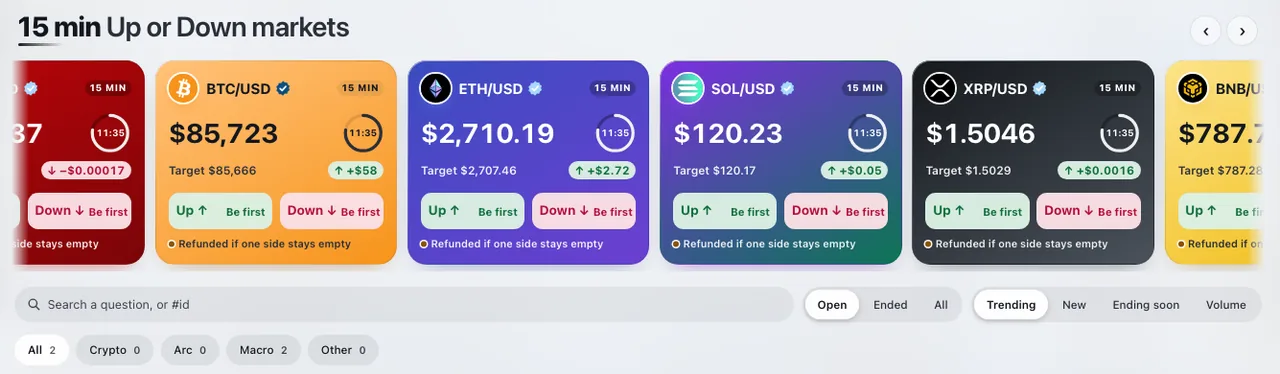
Up/Down rounds are a second, faster format on arky, also in USDC. Instead of shares from a market maker, every bet on a round goes into one pot, and the side that called the move on BTC, ETH, SOL or eight other coins splits it after RedStone price data settles the round. Rounds last 5 or 15 minutes and start at 1 USDC. The full rules, including when a round is refunded, are in Bitcoin Up or Down on Arc, and the wider landscape is in crypto prediction markets compared. The same balance also works for crypto perps on Arc and memecoins on Arc.
How do you place your first USDC bet?
- Open app.arky.bet and connect a wallet. Onboarding walks you through it.
- Deposit USDC to Arc with the Deposit wizard.
- Go to Predictions, pick a market and read its question, close time and settlement source.
- Choose YES or NO, enter an amount in USDC, check the quote and sign.
- After the market settles, redeem winning shares from the market page.
For a broader walkthrough of trading on Arc, read how to trade on Arc with USDC. To see how arky compares with the biggest venue, read arky vs Polymarket or the wider list of Polymarket alternatives.
You can lose what you put into a market. Rules for prediction markets differ by country; check your local rules and the arky terms before trading.
FAQ
How do USDC prediction markets pay out?
On arky each winning share redeems for 1 USDC and each losing share for 0 once the market settles. If a market resolves Invalid, every share redeems for 0.50 USDC. Payouts go straight to your wallet when you press Redeem.
Can I sell before a market closes?
Yes. Each market has a built-in market maker, so you can sell YES or NO shares back to the pool at the live price any time before the close.
Who decides the outcome of an arky market?
A resolver that arky has vetted, never the market creator. Price markets resolve from an onchain price feed; event markets are settled by arky's settler from named public sources and are labelled "Settled manually".
Do I need ETH to trade predictions on Arc?
No. Arc uses USDC as its gas token, so the USDC in your wallet pays for both your shares and the network fee.
Can Scout place bets for me?
Scout can propose a bet, a sale or a redemption, but your wallet signs every trade. After a fill, Scout checks the transaction on chain to confirm it matches the proposal.